
‘He was a really kind guy’: Mary Renshaw remembers Bon Scott as he would’ve turned 80
To mark what would have been Bon Scott’s 80th birthday, I spoke with Mary Renshaw – one of Bon’s closest and longest-standing friends.
Mary co-wrote Live Wire: A Memoir of Bon Scott by Three People Who Knew Him Best with John D’Arcy and Gabby D’Arcy, sharing a side of Bon that existed beyond the swagger, danger and rock’n’roll mythology.
Here, Mary remembers meeting Bon as an 18-year-old, making his clothes, watching AC/DC’s rise and the kind, funny and down-to-earth man behind one of rock’s greatest frontmen.
This interview has been lightly edited for clarity.
AMI: In honour of Bon Scott’s 80th birthday, we’re speaking to Mary Renshaw, one of Bon Scott’s besties from way, way, way back. She co-wrote the awesome book Live Wire with some of his other besties, and I’m also lucky enough to have her as a family member.
Mary, thanks for chatting with us on Radio Carrum.
MARY: Hi, Ami. How are you going on this cold Melbourne morning?
AMI: I’m freezing. I forgot to put the heater on in time, so I’m just hoping it warms up soon.
Are you keeping warm?
MARY: Yes, I am keeping warm, but I’m also packing because I’m going to celebrate Bon’s birthday in Darwin with my bestie Sarina. We’ve got our evening organised to celebrate just for him.
AMI: Beautiful. What does a celebration for Bon Scott’s birthday look like these days? Champagne, champagne and more champagne?
MARY: Usually, yes. Champagne and more champagne.
As I’ve gotten older, maybe a little bit less champagne and more really nice food with that champagne. But we’re definitely having some yummy birthday cake too.
AMI: Can you believe Bon Scott would be turning 80?
MARY: It’s pretty full-on, seeing as I met him in 1968 when I was 18. We stayed friends right up until the time he passed away in 1980.
For a while, I celebrated his birthday every year with his ex-wife Irene, from Bon’s Fraternity days. We’d always go out for a bit of a drink. Not so much food in those days, but definitely food nowadays.
AMI: I love that. Obviously, Irene passed away not too long ago, which was a terrible loss as well.
MARY: Yes. We’re going to put a little photo of Irene on our table outside in the sunshine. We’ll have a glass there for her too.
A pair of hippie beads at 10th Avenue
AMI: You mentioned that you met Bon when you were quite young – a teenager.
MARY: Yes, I was 18.
AMI: That’s so crazy, and I love this story. I won’t tell it, though. You can.
How did you meet Bon Scott?
MARY: I met Bon at an afternoon venue called 10th Avenue, which was quite a popular underage drinking place.
There weren’t very many rock’n’roll places where you could drink – or that served alcohol – in those days.
I was at 10th Avenue and he was in a band called The Valentines at the time.
During one of the breaks, I was downstairs. He came up to me and started asking about the beads I was wearing. They were hippie beads that I used to make for myself.
He asked if I could make some for him, and we basically became best friends from then on. We were always close friends over the years.
AMI: Did you end up making him some beads?
MARY: Of course I made him beads.
Another time I was wearing a little black velvet bolero that I’d decorated with sequins and stuff, and I made him one of those too.
Over the years, I think I made him a few different bits and pieces of clothing. I made some cool T-shirts with patches of snakeskin sewn onto them, and other things with diamantes.
AMI: That’s amazing.
MARY: He was fun to dress.
And undress.
AMI: I love that.
Tough enough, but kind
AMI: A lot of people think of AC/DC, and particularly Bon, as that wild frontman. This icon and legend with danger, swagger and rock’n’roll about him. Almost like a hard bloke.
But what about when the volume was turned down and he was in a more vulnerable state? What version of Bon do people not really recognise?
MARY: I was thinking about this last night. I was thinking about all the boys in AC/DC.
They all came from pretty roughish beginnings.
Mark was living in the commission flats in Prahran, and Prahran was pretty rough in those days. Angus and Malcolm had come over from Glasgow and were living in what was probably a poor area of Sydney.
Phil Rudd liked to steal cars and came from Preston, or wherever it was on the other side of town.
Bon was a few years older than them, but he’d obviously had to toughen up a little bit too.
All the new Australians who came here, whether they were from Europe or the UK, copped a bit of flak. You had to learn to stand up for yourself.
But all of those guys were really nice guys. You’d always want them there to back you up in a fight – and they would – but Bon was well-mannered. He loved his mum and dad. He came from a good family. He was fun and friendly.
The boys used to bring a roast around and I’d cook it for them.
They were just basic blokes with a lot of talent.
MARY: Bon was a really kind guy. He was a real good guy.
That’s why men loved him, women loved him and parents loved him.
AMI: He had a real warmth about him.
There are Bonfests all over the world now, and he remains such a legend to people. He’s constantly included on lists of the greatest frontmen to have ever lived.
Do you think it was that combination of private Bon and stage Bon that made people connect with him?
MARY: He was a fairly down-to-earth person.
The last time he was in Australia, we were at one of the nightclubs and there was a VIP section there, which I was used to always being in.
He was like, “Nah, I’m not going up there.”
He just wanted to hang out with the punters and have a chat with everybody.
But he was a massive showman too. It was this weird combination of being a guy who looked tough, ballsy and rock’n’roll on stage, but it was a big persona.
That showmanship also came through as him just being human. Really likeable.
The calling of AC/DC
AMI: I’ve always been curious about when he first joined AC/DC.
I remember reading in Irene’s book about him scoping them out and really considering, “Am I going to fit in here? Is this for me?” before giving it a go and owning the stage with them from the beginning.
MARY: His marriage to Irene was a little bit up and down at the time.
After leaving Fraternity and seeing the AC/DC boys, I think he was wondering, “Should I or shouldn’t I? Should I stay here in Adelaide and try to work on my marriage?”
What he told me was that he’d played with the band and done a little bit of rehearsal – or whatever they were doing. It wasn’t really a rehearsal. It was more like a jam.
Then they went back on the road to Sydney and he was starting a new job in some factory.
He started walking to work and then just went, “Fuck this.”
He packed his bags, left Adelaide and went to join AC/DC.
AMI: He had the calling.
MARY: It was the calling.
I think he was just like, “I’m too young to live a nine-to-five life.”
AMI: Which he wrote a song about.
MARY: Exactly.
He always wanted to be – not so much famous – but a well-known rock singer.
He probably gave up a lot for that. But he is a legend now.
Bonfest and a legacy that helps young musicians
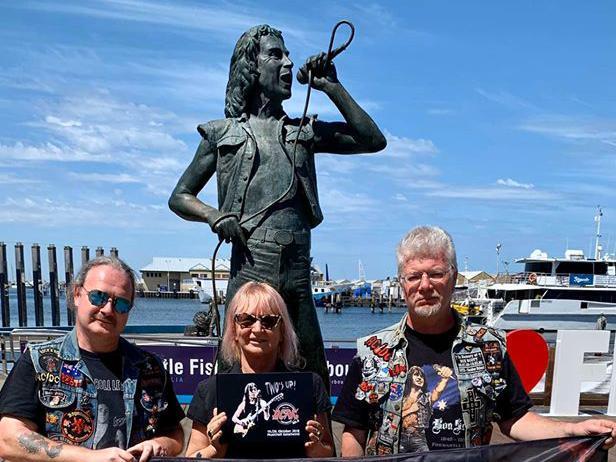
MARY: I’ve been going to Bonfest for years. Punters come from all over the world.
They got a whole lot of money together, along with DD8 Music, which runs Bonfest, and put the statue up in Bon’s Scottish hometown of Kirriemuir.
I was really lucky to be there to unveil that statue. Bonfest just gets bigger and better every year.
AMI: It’s incredible. From the photos I’ve seen, it looks amazing.
A statue of him! What do you reckon Bon would think of it all?
MARY: I think he’d be blushing, really, because it’s a little bit much.
But he’d also be loving it. I think he’d be so happy that all these people come from all over the world and have such a great time.
All the money DD8 Music makes goes back into it. It’s a charity organisation that helps provide instruments for kids who want to learn and play music.
For Bon to feel that he’s still doing something really good for young people, I think he’d love that.
AMI: That’s an incredible legacy.
MARY: Exactly. It’s not there to make people rich. It’s there to help kids.
What was Bon like at parties?
AMI: I’ve never asked you this before, but what was Bon like at parties?
With someone like Bon, you might imagine he’d be the star of the show in every room. Was he like that, or was he more of a watcher?
MARY: Not at all. He just wasn’t that sort of person.
People would flock to him, though.
When he came to take me to lunch while I worked at the In Shop, my design room was upstairs.
It was a big shop and there was a record bar at the front. By the time he got through the front door, reached the lift and came upstairs, it would take a while because he’d be signing autographs.
Then, by the time we went back downstairs to leave the shop and go to the pub next door to get drunk, there would be heaps of people wanting his autograph.
We’d also have to go to Coles first because he’d need to buy a pair of thongs. He always walked around with no shoes on during summer.
We’d buy him some thongs, then we’d go to the pub.
AMI: That sounds perfect. A perfect way to spend your lunch, really.
What sorts of things made Bon laugh? What kind of sense of humour did he have?
MARY: He was pretty funny. Sometimes he had a bit of a dirty sense of humour – obviously, like his music.
But he laughed easily. Just normal stuff, really.
Sometimes the boys would come to lunch with us and we’d all have a giggle about anything.
Watching a friend become a superstar
AMI: It must have been interesting knowing someone before they became this legendary name and watching that evolution.
What was it like seeing Bon go from your friend who asked you to make him beads to this superstar?
MARY: It was pretty full-on.
They started as just these guys, and then suddenly Bon was writing to me about what was happening overseas, the audiences they were getting and who they were playing with.
I’ve still got a few letters from him.
When he came back to Melbourne, he might talk about it a little bit, but he wasn’t that interested in talking about all of that. He was more interested in having fun with his friends and family.
Even now, when I go to shows and see how many people are there, it brings a tear to my eye.
When I went to see AC/DC in Berlin and France, I couldn’t believe the number of people there.
You see the Australian audiences, but I knew them when they were playing in really small venues and pubs. Then suddenly, over there, they were playing in front of 100,000 people or whatever it was.
It was hard to comprehend.
After Bon passed away, I saw what it was like throughout Europe. Then, of course, with all the shows they did with Brian Johnson after Bon passed, they just kept getting bigger and bigger.
It was pretty full-on.
It still pisses me off that Bon didn’t get the money. The money came in later, if you know what I mean.
AMI: Absolutely. It’s often the way for true artists.
You hear it all the time with painters, photographers and fashion designers too. Maybe there’s something about appreciating what you had once it’s gone.
MARY: Bon wrote ‘Ain’t No Fun (Waiting Round to Be a Millionaire)’, but he missed that last little bit.
The millions came in later. Not that much later, but obviously after he passed away.
They were touring throughout Europe and the UK and were already very, very popular. They were just waiting to break the American market.
The new album was going to be the one.
He didn’t say it was going to be called Back in Black, but he was 100 per cent sure this new album they were going to make would break them in America.
America was already starting to love them. It was just about getting that top album recorded.
If it didn’t make it, he thought he might have a rest because they’d flogged themselves travelling around the world. It was a really hard slog.
America was going to be the one.
AMI: Was he pretty burnt out towards the end?
MARY: He was pretty burnt out. He was tired, and he really wanted this album to be the one.
If it wasn’t, I think he might have given it up.
But really, that wasn’t in his spirit. He didn’t truly think that was going to happen.
He was tired, but he was really looking forward to getting the new album done. He was joyful about it.
AMI: He was ready to hit that next level.
MARY: Yeah. “America’s going to love us.”
AMI: And they do.
MARY: You only have to go to Bonfest and see people travelling from all over the world.
People love AC/DC as they are now, but they also just love old AC/DC – and they love Bon.
Dressing the next generation of Bon Scott fans
AMI: When you go to Bonfest, you make those cute little outfits for the kids with AC/DC and Bon Scott patches on their jackets.
It feels like a beautiful full-circle tribute. When you first met Bon, you were making him things through your fashion background. Now you’re doing it to carry on his legacy.
Did you plan it that way, or did it just happen?
MARY: I didn’t plan it that way.
I saw all the adults at Bonfest wearing those little cut-off denim jackets with patches all over them. I thought, “Maybe I should make some.”
Then I realised it would be so much work.
I thought, “No, little kids need them. They’re going to look so cute on little kids.”
I buy little denim jackets from the op shops and decorate them. They look fabulous on the kids, and the kids love them.
AMI: They look so good. I love them.
I won’t keep you much longer because you have to go and celebrate Bon’s birthday.
MARY: Yes. I’m just going to finish the last of my packing.
AMI: Then you’re off to sunny, warm Darwin, which will be a little nicer than Melbourne.
MARY: Yes, for sure.
‘Follow your dream’
AMI: There are so many deeply committed Bon Scott fans.
What do you think he would want to be remembered for? I know you probably don’t want to speak on his behalf, but is there a human detail, gesture or habit that has stayed with you – something you think people should know?
MARY: I think he’d like to be known as the legend he is, really – and as a good guy.
Don’t give up. Follow your dream.
AMI: I love that.
MARY: It’s as simple as that.
He worked hard for his dream. What happened, happened in the end.
But now look at him. He’s a legend.
AMI: He sure is.
Thank you so much. Enjoy toasting Bon and have one for me.
MARY: I definitely will.
AMI: For anyone interested in reading more about that human side of Bon Scott – the man, rather than only the wild frontman – Mary’s book Live Wire is a fantastic read.
There are plenty of surprises in there, and I reckon you’ll feel like you know him by the end of it.
MARY: I think so too.
AMI: Thank you so much, Mez. Have a wonderful time in Darwin – and happy birthday, Bon Scott.
MARY: Happy birthday, Bon!