
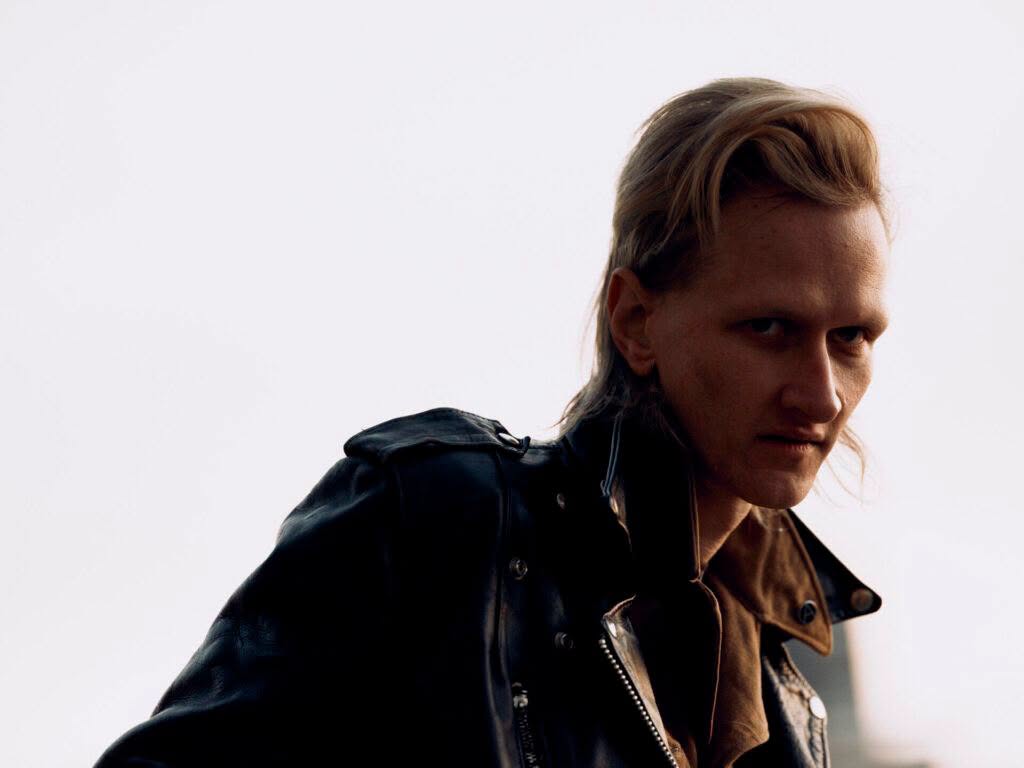
In the Radio Carrum studio before a sold-out Frankston show with Keli Holiday in May 2026, Spike Fuck and his bloody delightful girlfriend Cllawde talk sobriety, religious mania, reinvention and the new record, Evidence – a record that may or may not be art.
Before we cover the music, sobriety and God, we spend several minutes discussing a sheet of A4 paper in a kebab shop, as you do.
On their way to the studio, Spike and Cllawde had stopped at a place in Frankston with exceptional food and strange pictures on the walls. One appeared to show a vase sitting in a recessed nook. Except there was no nook. No vase either. Just a printed image creating the suggestion of both.
“The wall doesn’t have a nook,” Spike explains. “But you would think it would if you weren’t looking hard enough.”
Cllawde calls it a “faux decal kind of item”, then clarifies: “The image of having a shelf.”
It feels like a throwaway conversation. It also turns out to be a useful way into Spike Fuck: the thing and the image of the thing, close enough to mistake for each other.
THE NAME THAT STUCK
Spike Fuck has been called elusive, mysterious, an enigma of the Melbourne music scene. Spike seems mildly amused or surprised by this, and not especially invested in preserving it. When I ask whether it is possible to purposefully craft yourself into an enigma, the answer is practical.
“It just takes a while,” Spike says. “Takes, like, ten years. And, like, a three-year hiatus.”
The name probably helps. Spike chose it because it was “the most stupid name I could think of”. Then it stuck.
“I figured I wanted to change it, but there was nothing I could change it to. Nothing worked. So here I am.”
At one point, a doctor (who let it be known only sees people under the cover of darkness) suggested Spike Luck. Spike still likes it and so does his mum, so maybe that’s the next incarnation (TBC).
While the name Spike Fuck is kinda confrontational, abrasive, intense, there is no denying that the person sitting in the studio is warm, funny and given to digressions about tea, accents and the merits of Wham.
“If anybody asks, good guy,” Spike says. “I’m a good guy.”
And he’s bloody right about that.
MY DOCUMENT, MY EVIDENCE
The three-year hiatus was not empty time. I ask what a musician is without music.
“If you’re an artist, you pursue creativity in a different way, even if you deny that it is,” Spike says.
For a while, that other way was religion.
“I became very religious for a time and denied that I wanted to make music. I thought music was sort of this – pop music was this vulgar, like it was a bad thing. And my music was a bad influence or something.”
Even then, Spike sought out particular churches to hear choirs sing Mozart and listen to chants.
That contradiction now sits near the centre of Evidence, the new record Spike is preparing to release. One of the proposed PR lines is that it is “not art”.
“It’s my document. It’s my evidence,” Spike says.
Then, almost immediately: “Well, I’m clearly an artist, so why do I feel the need to be so special by not being an artist, or claiming that I’m not an artist? I’m not sure.”
An earlier album had shifted drastically between its first conception and what was eventually produced. Evidence was built to resist that.
“The whole mission statement was: we basically write and record in the studio,” Spike says. “Whatever comes out – the emotion, the feeling, the vibe, imperfect as it is – will be much more vital and impactful that way.”
The record was produced with Adam Hyde, who performs as Keli Holiday. In the studio, their shared language was arguably dangerously enthusiastic I’m told. Every idea was the best idea ever. Every contribution was genius. There is always a risk that this kind of mutual belief will make a record overwrought.
“But luckily it didn’t happen,” Spike says. “I think God ordained this record to be, and so He wouldn’t allow us to mess it up in any kind of way.”
With Spike, humour and sincerity rarely stay in separate lanes. I think it’s all real.
Did I mention we had a little listening party of some of his then unreleased tracks? The first track we hear, Getting Sober, is introduced as a song about religious mania – not quite the self-explanatory title I had assumed.
“When you get sober, you can go through a period of insanity because you just think you’ve got a new lease on life,” Spike says. “You’re like, ‘I’m just gonna start all over again.’ So it’s a bit tongue in cheek, but it actually kind of tells a true story.”
THE TRUTH ABOUT GOD
I was raised oblivious about religion (my main understanding of it was as it pertains to the nativity play at school. I was a wise man who came bearing myrrh fyi).
Depsite a solid exploration of religion, namely Catholicism, Spike was not raised with much knowledge of it. The later turn towards religion came through theology, philosophy and a desire to identify the one thing that was true.
“Whatever I pick, it’s gotta be the truth,” Spike says. “I wanted the truth.”
Russian Orthodoxy had aesthetic appeal. Catholicism seemed baroque and over the top. It also became the closest available path, and Spike practised devoutly for several years.
The return to music did not resolve the question of faith. It made the position more complicated.
“I essentially can’t deny that it’s true. It’s true. God is real. I think God is probably Christ, but I just don’t wanna do the things that that sort of conclusion would demand of me.”
Belief remains, along with resistance to its consequences.
“Which leaves me in a very difficult position,” Spike says, “because if I’m right, I could be going to hell.”
We briefly decide hell might at least be warmer, then move on to All By Myself. The song begins with annoyance and the wish to be left alone, but does not romanticise isolation.
“Ultimately, it’s slightly tongue in cheek because you can’t just be alone,” Spike says. “It’s sad.”
When I ask whether the goal is a hit, there is none of the expected ceremony about pure motives.
“It’s bullshit,” Spike says of musicians claiming they only do it for love. “We do it for the hit. We want a hit.”
The money would be nice too, if there were any. The true luxury of wealth is of course not having to choose between an entrée and dessert.
A CHEMICAL REACTION
Spike’s reinventions seem less like strategy than a sequence of genuine convictions. The audience is usually one step behind.
“They don’t like what I’m doing until after I’ve stopped doing it,” Spike says. “And then they’re like, ‘Oh, but what about that?’”
The old version becomes desirable at the precise moment it is no longer available. Isn’t that always the way…
Later, we talk about the different versions of ourselves that appear around different people. I call it an identity crisis. Cllawde objects to the word crisis.
“I think we bring out different things from different people,” she says. “Different interactions, different relationships. It’s not a crisis. It’s just like a chemical reaction.”
It is the most generous reading of multiplicity offered all afternoon. Identity can change in contact with someone else without becoming false.
Cllawde doesn’t just observe the work – she has been inside the making of its world. On the physical side of things for one, she and Spike have been working together to create the insert for the record’s pressings. She calls the state they entered “art psychosis”.
“Art psychosis is when you spend a long amount of time with another person or other people creating something, and you just become so fixated doing this one thing,” Cllawde says. “You go a bit crazy because it’s like your baby. You’re bringing this thing into the world. That’s all that you’re doing, and you don’t even see outside. You’re just locked in.”
Spike stayed up through the night teaching himself Photoshop and writing the acknowledgements. Cllawde had gone to bed after giving him one more hour to wrap things up. At six in the morning, he was still awake, reading.
This, Cllawde reminds him, was the last time he cried.
“I think it all washed over you,” she says. “Like, ‘Oh, this is happening.’”
For someone calling the record a document, it is telling that the emotional break came while writing the acknowledgements: the record of who had helped make it.
Spike’s explanation is simple.
“Life is cool sometimes. You realise that you should be very lucky. And even though there’s dark looming things in the background, you know, there’s a lot of beauty.”
THE VERY MALLEABLE THING
By the end of the interview, Spike and Cllawde need to leave for soundcheck at The Pier. The show with Keli Holiday is sold out. There is time for one final question: what do people think they know about Spike Fuck that is completely wrong?
“No one knows anything,” Spike says. “Everything I said could’ve been a lie.”
“And it is. Or it isn’t.”
I suggest that truth changes.
“It does,” Spike says. “Very malleable thing.”
People change. Convictions arrive and loosen. A perhaps silly name idea becomes permanent and entwined with an identity and body of work. A musician quits music and goes looking for it in church. A believer believes and resists. A record becomes Evidence of the person who made it.
Evidence is yours to do with as you please, here.
Listen to the whole interview here
Editorial note: This interview was conducted at Radio Carrum. Quotes have been lightly edited only to remove false starts and repetition; the speakers’ wording has otherwise been preserved.